

Look, the honeymoon phase for "AI" is officially over.
If you’ve been paying attention to the markets over the last year, you’ve seen the pattern. Every two-bit software company slapped "AI" on their landing page, pumped their stock, and then watched it crater when the earnings didn’t show up. The "Wall Street suits" fell for it, but the operators - the guys actually building and buying - knew better. We’re moving into what I call AI 2.0. This isn't about chatbots that write bad poetry. It’s about infrastructure that solves expensive problems for massive companies.
The market is choppy, and frankly, it’s going to get worse for the companies that don't have a real business model. But for the ones that do? The growth is insane. I’m talking about the kind of growth that makes early-stage Nvidia look like a savings account. Most people missed the boat on the hardware side of the AI boom. They’re about to miss the boat on the software side too, because they’re too busy listening to the noise on CNBC to see the concrete signals right in front of them.
We’re seeing a shift where performance matters more than promises. If your tech doesn’t deliver a 3X return on investment, you’re dead in the water. But if it does? You’ve got a license to print money. Let’s talk about who’s actually winning this game and why the "get in early" window is closing faster than you think.
Why Fortune 1000s Are Ditching Legacy Tools for This AI

Listen, the biggest problem in marketing right now isn't a lack of data. It’s too much of it. Most companies are drowning in "signals" but can't find a single customer who actually wants to buy their product. This is where RAD Intel comes in. While everyone else was chasing the latest hype cycle, these guys spent 14 years in R&D building an AI that actually understands audience behavior.
This isn't some overnight success story. It’s a 127% CAGR (Compound Annual Growth Rate) over the last four years. That kind of growth doesn't happen by accident. It happens because brands like Sweetgreen are seeing a 188% boost in ad performance. It happens because MGM is hitting a 3.3X ROI on their ad spend. When you can walk into a Fortune 1000 boardroom and prove - with data - that you can triple their money, they don’t just sign a contract; they sign a seven-figure recurring deal.
That’s exactly what’s happening with Omnicom Media Group and Hasbro. We’re talking about an $18B market cap giant like Omnicom choosing a startup's tech because the legacy tools are broken. The old way of targeting - throwing spaghetti at the wall and hoping it sticks - is dead. AI 2.0 is about precision. It’s about knowing exactly who the customer is before you even show them the ad. RAD Intel isn't just another "AI company." They are the "ROAS King" because they’ve built a platform that delivers consistent, repeatable results.
If you’re looking for a sober way to play the AI shift, you stop looking at the "wrappers" and start looking at the infrastructure. RAD Intel has doubled its revenue heading into 2026. They’ve doubled their sales contracts in 2025 alone. This is the "operator detail" I always talk about - real contracts, real revenue, real ROI. Everything else is just bullshit.
$9B in Experience and $60M Raised

Now, let’s talk about who’s actually steering the ship. In the startup world, you bet on the jockey, not just the horse. RAD Intel is led by Jeremy Barnett and Bradley Silver - three-time founders who have already successfully exited businesses. These guys aren't kids in a garage; they’re seasoned operators who know how to scale.
But it’s not just them. They’ve surrounded themselves with an executive team that has $9B in M&A (Mergers and Acquisitions) experience from places like Omnicom, L’Oréal, and Mars. Why does that matter to you? Because RAD Intel isn't just growing organically; they’re hunting. They are pursuing what they call AI-enhanced buyouts (AIBOs) of agencies with $5M to $50M in revenue.
Think about the logic here. You take a traditional marketing agency that’s doing okay but struggling with margins. You buy them, plug in RAD Intel’s AI to automate the bullshit and 3X the client results, and suddenly that "okay" business becomes a high-margin growth engine. It’s a multiplier effect. This is the same strategy that early tech giants used to dominate their industries.
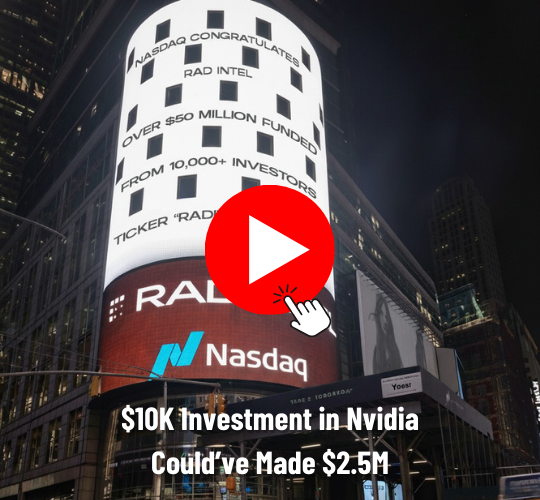
And the "smart money" is already there. When you see names like Adobe and Fidelity Ventures on the cap table, you know the due diligence has been done . These aren't the kind of firms that throw money at hype. They invest in platforms that can scale globally. With over $60 million raised from 14,000 investors, the momentum is building toward something much bigger than a private startup. They’ve already reserved the Nasdaq ticker $RADI. When a company starts reserving ticker symbols, the "ground floor" opportunity is officially on the clock.
From $5M to $200M

Let’s get into the numbers, because that’s where the real story is. Most people see a $0.85 share price and think "penny stock." That is a massive mistake. You have to look at the valuation trajectory. RAD Intel’s valuation has surged from $5 million to over $200 million in just four years. That’s a 5000% rise.
But here’s the kicker - the "concrete signal" that most people are missing. On Hiive, a secondary market platform where private shares are traded between institutional and accredited investors, RAD Intel was recently valued at $12.08 per share.
Read that again.
The private market is trading these shares at over $12, while the current Reg A+ offering is still at $0.85. That is a massive valuation gap. It’s the kind of arbitrage opportunity that usually only the "Wall Street suits" get to see. Why is there a gap? Because the Reg A+ allows regular investors to get in at the set price before the company hits the public markets.
We’ve seen this movie before. Think back to the early days of Amazon or Meta. The people who made the generational wealth weren't the ones buying on the day of the IPO. It was the ones who got in when the company was still scaling, when the revenue was doubling every year, and when the big boys like Adobe were starting to take notice. RAD Intel has funded eight successful rounds since 2020. They aren't just "trying" to raise money; they have a proven track record of investor appetite. With $11.7M already committed in the current round at a $93M valuation, the window to grab shares at $0.85 is closing.

Bottom Line
So, what’s the play here?
Look, I’m not here to tell you that every AI company is going to be the next Nvidia. Most of them are going to fail. They’re going to run out of cash because they don't have a real product that solves a real problem. But RAD Intel is different. They’ve got 14 years of R&D. They’ve got Fortune 1000 clients like Skechers seeing 89% higher engagement. They’ve got a leadership team that has handled $9B in deals.
And most importantly, they have a clear path to liquidity. They’ve reserved $RADI on the Nasdaq. They are doubling revenue year-over-year. They are executing a buyout strategy that could multiply their footprint overnight.
The "Mainstream media" will tell you about this company six months after it goes public, once the price has already been bid up by the big funds. That’s how the game is rigged. But right now, you have the data. You see the 127% CAGR. You see the $12.08 private market valuation. You see the 3-4X ROI they’re delivering for brands like MGM.
Don't be the guy who looks back in 2030 and says, "I remember reading about that AI marketing company when it was $0.85." The opportunity is to act while the signals are clear but the crowd is still distracted.
Frankly, the math speaks for itself. The tech is proven, the clients are massive, and the ticker is waiting.
